India’s Soil is Dying: The Natural Farming Blueprint to Break Free from Chemical Dependency
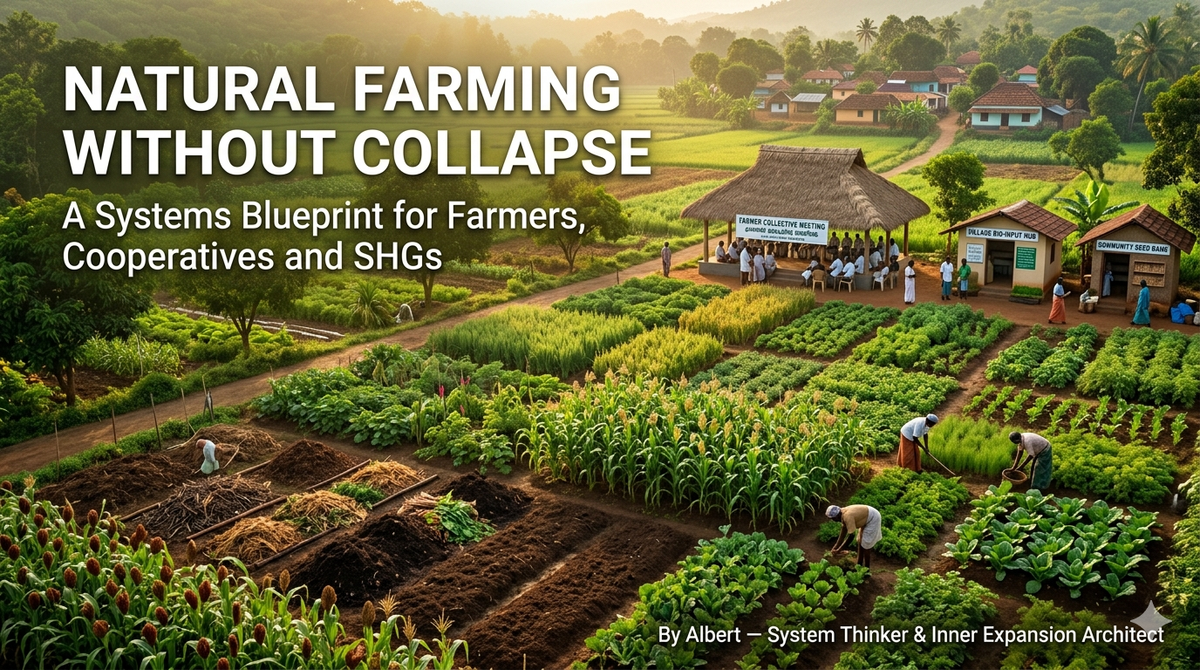
By Albert Y Zacharia System Thinker | Governance Philosopher | Inner Expansion Architect
India’s chemical fertilizer addiction is bankrupting soils, farmers, and the economy. The PM’s natural farming push is our last chance but only if we replace top-down mandates with a Soil Sovereignty Ecosystem. Here’s the step-by-step playbook with cooperatives, cottage industries, and decentralized governance.
Opening
India’s soils are overdrawn. For 70 years, we’ve mined them like a bank account endlessly withdrawing nutrients and pumping in synthetic chemicals. Now, the balance is negative. The Prime Minister’s call to transition to natural farming is visionary, but without a systems-thoughtful blueprint, it risks becoming another top-down failure. This is how to do it right.
1. The Soil is Bankrupt
India’s soils are clinically bankrupt. Decades of chemical farming have left them exhausted, acidic, and unable to retain water or nutrients. The numbers tell a damning story:
- 30% of India’s land is degraded (NASA, 2022).
- Soil organic carbon has dropped below 0.5% in 60% of districts (ICAR, 2021).
- Farmers spend 30–40% of their income on fertilizers, up from 10% in 2000 (NITI Aayog).
We’ve borrowed from the soil’s future to feed today’s hunger. Now, the bill is due.
2. The PM’s Call is Right—But the Plan is Flawed
Prime Minister Narendra Modi’s appeal to transition to natural and organic farming is visionary. It aligns with:
- Soil health (the foundation of food security).
- Climate resilience (carbon sequestration).
- Economic sovereignty (reducing $15B/year in fertilizer imports).
But vision without execution is just another speech. The flaw? It’s a top-down mandate without a bottom-up ecosystem. Natural farming isn’t a policy—it’s a system. And systems fail when they ignore the people within them.
3. The Farmer’s Debt Trap
Behind the numbers are human lives. The system doesn’t just fail farmers—it designs them to fail.
- 50% of farmer suicides are linked to debt (NCRB, 2021).
- 70% of Indian farmers are smallholders (<2 hectares), with no buffer for failed harvests.
- Chemical farming is a Ponzi scheme: Yields rise for 5–10 years, then crash as soils acidify. Farmers respond by borrowing more for inputs.
The cycle is brutal: subsidies → debt → more chemicals → soil death → more subsidies.
4. First Principles: Soil is a Living System, Not a Factory
We’ve been farming wrong for 70 years. Here’s what we got wrong:
Myth: More inputs = more yield. Truth: Soil is a microbiome. Its productivity depends on:
- Microbial diversity (1 gram of healthy soil = 10,000 species).
- Carbon sequestration (healthy soils store 3x more carbon than degraded ones).
- Water retention (organic matter holds 18x its weight in water).
Chemical farming disrupts this. It kills fungi, acidifies soils, and creates dependency. Natural farming restores it.
5. Systems Thinking: The Chemical Feedback Loop
Here’s how the system traps farmers:
- Subsidies make chemical fertilizers artificially cheap.
- MSP (Minimum Support Price) incentivizes monocultures (rice, wheat, sugarcane).
- Monocultures deplete soil → farmers apply more chemicals.
- Soil death → yields fall → farmers borrow more.
- Debt cycle → more suicides, more subsidies.
It’s not a farming system—it’s a debt extraction machine.
6. Design Thinking: Farmers Don’t Hate Organic—they Hate Uncertainty
Farmers resist change when:
- Risk is high (no safety net for failed transitions).
- Knowledge is scarce (extension services are underfunded).
- Markets are unstable (organic premiums don’t reach farmers).
Solution: Design for risk redistribution.
- Cooperative societies can pool knowledge and resources.
- Income stabilization funds can cover transition losses.
- Cottage industries can absorb surplus labor.
Farmers don’t resist organic farming—they resist unplanned organic farming.
7. The 5 Counterintuitive Truths About Natural Farming
Truth 1: Myth: Organic = lower yields.
Reality: With proper composting and microbial inoculation, yields can match chemical farming in 3–5 years. Example: Andhra Pradesh’s ZBNF pilots showed 10–20% yield increases in 3 years.
Truth 2: Myth: Natural farming is labor-intensive.
Reality: It redistributes labor. Instead of 100 days of chemical spraying, farmers spend 50 days on composting—but those 50 days create value-added products (vermicompost, biofertilizers) sold locally.
Truth 3: Myth: Co-ops are inefficient.
Reality: They’re the only scalable way to aggregate risk. Example: Amul’s dairy co-ops transformed Gujarat’s rural economy.
Truth 4: Myth: Cottage industries can’t compete.
Reality: They can if we redefine "competition." Example: A village-level biofertilizer unit doesn’t compete with Bayer—it replaces Bayer’s imports.
Truth 5: Myth: Natural farming needs government handouts.
Reality: It thrives on decentralized governance. Example: Kerala’s Kudumbashree model shows how SHGs can drive grassroots change.
8. The Soil Sovereignty Ecosystem
A systems-level solution:
- Farmer Collectives → Aggregate land, knowledge, and bargaining power.
- Cooperative Processing → Turn farm waste into biofertilizers, vermicompost, and natural dyes.
- Local Markets → Sell surplus to urban consumers (premium organic) and export niche products.
- Policy Feedback Loops → Data from cooperatives informs subsidies (e.g., pay farmers for soil carbon sequestration).
Result: A circular economy where waste = input, imports = local production, and debt = equity.
9. The 7-Stage Playbook
Stage 1: Awareness
- Soil health audits via community labs (using low-cost tools like the "Soil Your Undies" test).
- Farmer-to-farmer knowledge exchange (no more top-down extension services).
Stage 2: Diagnosis
- Map microclimates, crop suitability, and labor availability.
- Identify "transition champions" (early adopters who can mentor others).
Stage 3: Reframing
- Shift from "yield maximization" to "soil capital appreciation."
- Use gamification (e.g., "Soil Health Scorecards") to track progress.
Stage 4: Intervention
- Gradual transition (e.g., 20% chemical reduction per year).
- Income stabilization funds (e.g., 50% of transition losses covered by cooperatives).
Stage 5: Feedback
- Real-time yield/soil data via farmer cooperatives.
- Adaptive learning cycles (e.g., "What worked in Punjab may fail in Tamil Nadu").
Stage 6: Iteration
- Scale successful models horizontally (e.g., SHG networks).
- Pilot "soil health markets" where farmers earn carbon credits.
Stage 7: Scaling
- Horizontal replication via Self-Help Group (SHG) networks and Farmers Producer Organizations (FPOs).
- Policy advocacy: Push for state-level "Soil Health Missions" that fund cooperatives, not just chemical subsidies.
- Corporate partnerships: Engage ethical agribusinesses (e.g., ITC’s e-Choupal) to source from natural farming collectives.
10. Why Andhra Pradesh’s ZBNF Failed—and How to Fix It
What happened:
- Top-down rollout: The state government mandated ZBNF without farmer buy-in.
- No market linkages: Farmers produced organic but had no buyers.
- Knowledge gaps: Extension workers lacked training in natural farming.
What to do differently:
- Start with willing farmers (not mandates).
- Build market access first (e.g., tie up with organic retailers like BigBasket).
- Invest in extension services (e.g., mobile apps with soil health tips).
Lesson: Natural farming isn’t a policy—it’s a movement.
11. The Cottage Industry Engine
How local value chains replace imports:
|
Input |
Cottage Industry Solution |
Economic Impact |
|
Biofertilizers |
Vermicompost units in every village |
Replaces $2B/year in chemical imports |
|
Natural Pesticides |
Neem oil, cow urine distilleries |
Reduces farmer health costs |
|
Soil Amendments |
Biochar kilns (using farm waste) |
Sequesters carbon, improves water retention |
|
Value-Added Products |
Organic millets, turmeric, spices |
Exports fetch 30–50% premium |
Example: Khadi and Village Industries Commission (KVIC) already produces biofertilizers—scale this model.
12. The $21 Billion Question: What’s the Cost of Doing Nothing?
|
Cost Factor |
Annual Cost (USD) |
Source |
|
Soil degradation |
$6.4B |
World Bank (2020) |
|
Chemical fertilizer imports |
$15B |
Ministry of Chemicals (2023) |
|
Farmer health costs (pesticide poisoning) |
$1.2B |
Lancet (2019) |
|
Total |
$22.6B |
Opportunity cost: If we transition to natural farming, we could:
- Save $22B/year.
- Create 50M rural jobs (via cottage industries).
- Reduce carbon emissions by 10% (soil sequestration).
13. 2047 Vision: A Nation That Feeds Itself
Imagine India in 2047:
- Soils are thriving: Organic carbon levels restored to 1.5–2%.
- Farmers are prosperous: Cottage industries employ 100M rural Indians.
- Imports are history: Biofertilizers and natural pesticides replace chemical ones.
- Exports are premium: India sells "soil health" as a brand (like Darjeeling tea).
This isn’t utopian—it’s a systems hack.
14. The Farmer’s Compact
We will not beg for subsidies. We will not wait for mandates. We will demand soil sovereignty.
How?
- Join a cooperative (or start one).
- Demand soil health audits from your local government.
- Push for cottage industries in your village.
- Vote for leaders who fund soil, not chemicals.
The soil is dying. But the farmer is not.
Conclusion
India’s natural farming transition is not just about soil health—it’s about economic sovereignty, climate resilience, and rural prosperity. The path forward isn’t paved with mandates or subsidies, but with cooperatives, cottage industries, and decentralized governance.
The soil is bankrupt. The farmer is trapped. The time to act is now.
Call to Action
Comment below:
- What’s the biggest challenge in switching to natural farming in your region?
- Tag a farmer, policymaker, or entrepreneur who needs to see this.
- Follow for more on how systems thinking can transform rural India.
FAQ Section
1. Won’t natural farming reduce food production? No. Studies (e.g., Andhra Pradesh’s ZBNF pilots) show yields can match or exceed chemical farming in 3–5 years with proper composting and microbial management.
2. How will farmers survive the transition? Income stabilization funds (e.g., 50% of transition losses covered by cooperatives) and cottage industries (e.g., vermicompost, biofertilizers) will provide alternative income.
3. Is natural farming scalable? Yes. The Soil Sovereignty Ecosystem model uses SHGs and FPOs to scale horizontally. Example: Amul’s dairy co-ops transformed Gujarat’s rural economy.
4. What about pests and diseases? Natural farming uses integrated pest management (IPM) and crop diversity to reduce outbreaks. Chemical pesticides create resistant pests—natural systems prevent them.
5. How can the government support this? Fund cooperatives, not chemical subsidies. Pay farmers for soil carbon sequestration. Invest in extension services for natural farming.
Sources
- NASA Soil Degradation Report (2022)
- ICAR Soil Organic Carbon Study (2021)
- NITI Aayog Farmer Income Report (2020)
- NCRB Farmer Suicide Data (2021)
- Andhra Pradesh ZBNF Pilot Results (2019–2023)
- World Bank Soil Degradation Costs (2020)
- Lancet Study on Pesticide Poisoning (2019)
- Ministry of Chemicals Fertilizer Import Data (2023)
- KVIC Biofertilizer Production Reports
- BigBasket Organic Sourcing Data