The Unconscious State: Why You Cannot Build a Free Society with a Slaved Mind
The Unconscious State: How Inner Decentralization Enables True Participatory Governance
Albert Y Zacharia exposes the missing link in governance reform: the unconscious mind. Discover why true federalism and participatory democracy require the "Inner Coup" of silent writing.
We demand free societies while living in unconscious chains. The path to true decentralization doesn't start with policy. It starts with a pen, a notebook, and a 10-minute coup against the inner dictator. Read the manifesto for the decentralized soul.
The Unconscious State: Why You Cannot Build a Free Society with a Slaved Mind
By Albert, A System Thinker and Inner Expansion Architect
Stop.
Put down the mental list of everything you have to fix today. Step away from the algorithmic noise pulling you in seventeen directions. Close the part of your mind that is already preparing to scroll past this, searching for the next "solution."
Because what is about to be discussed is not a policy tweak. It is not a new voting mechanism. It is not a constitutional amendment.
It is the thing.
The one simple act that, the moment you actually do it, reorganizes the entire structure of your life and, by extension, the society you are trying to build.
We are living in a paradox. We demand participatory governance. We scream for decentralization. We call for the dissolution of the central state. Yet, the more we fight for these structures, the more entrenched the centralization becomes. The more we demand freedom, the more we find ourselves enslaved by the same old patterns, the same polarization, the same apathy.
Why?
Because you cannot build a free society with a slaved mind.
You cannot create a system of federalism and constitutional rights when the citizens operating it are running on an operating system they do not control. You cannot decentralize power if your own internal power structure is a dictatorship of the unconscious.
The missing variable in every political theory, every governance model, and every movement for progress is the Inner State.
The Hidden Governor
Carl Jung, the depth psychologist who mapped the terrain of the human soul, discovered something that the architects of modern democracy ignored. He discovered that the conscious mind, the small voice you call "I," is only a tiny fraction of who you actually are.
Beneath your awareness lies a vast reservoir. Jung called it the unconscious.
Within that unconscious live your repressed memories, your inherited traumas, your buried emotions, your unmet childhood needs, and your rejected aspects of self. All of it is operating beneath your awareness, driving your choices, attracting your circumstances, and shaping your political leanings with a precision that the conscious mind cannot match.
Jung said something that the modern citizen refuses to hear:
"Until you make the unconscious conscious, it will direct your life and you will call it fate."
This is why your political life never actually changes. Not really. You change the candidates. You change the parties. You change the slogans. You change the "progressive" or "conservative" label you wear.
But underneath, the same patterns repeat. The same polarization. The same outrage. The same inability to listen. The same collapse into tribalism.
Why? Because the unconscious has not changed. And the unconscious is the actual operating system of the citizen.
When we try to build participatory governance without addressing this, we are building a decentralized network of unconscious automatons. We are asking people to participate in a system they do not understand, to govern a state they cannot control, because they cannot even govern themselves.
First Principles of the Citizen
Let us strip this down to first principles.
What is a citizen?
The conventional definition is a person with the right to vote, to hold office, and to participate in the political process. This is a legal definition. It is surface level.
The true definition, the one that matters for decentralization, is different.
A citizen is an individual who has achieved self-governance.
A citizen is someone who has made the unconscious conscious. Someone who knows their own shadow. Someone who can distinguish between their own genuine will and the projections of their trauma.
If a person cannot govern their own impulses, cannot hear their own inner voice amidst the noise, and cannot take responsibility for their own projections, they are not a citizen. They are a subject. They are a subject of their own unconscious, and therefore, they are easily manipulated by external subjects of power.
You cannot have a participatory democracy of subjects. You can only have a mob.
The constitutional rights we fight for are meaningless if the mind holding them is not free. The right to vote is a hollow privilege if the voter is acting out a script written by their childhood trauma or their fear of the "other."
True federalism the distribution of power from the center to the periphery cannot exist until power is distributed from the Ego to the Self within the individual.
The Shadow State
Every political system is an externalization of the internal state of its people.
When a society is dominated by fear, the system becomes authoritarian. When a society is dominated by greed, the system becomes extractive. When a society is dominated by repressed anger, the system becomes polarized.
This is the Shadow State.
It is not a government building. It is not a legislative body. It is the collective unconscious of the people, projecting its internal conflicts onto the external world.
You see this in the way we fight. We do not fight for ideas. We fight for our shadows. We project our own unacknowledged rage onto the "opposing party." We project our own fear of poverty onto the "welfare recipient." We project our own shame onto the "outsider."
This projection creates a feedback loop. The more we project, the more we create enemies. The more enemies we create, the more we feel threatened. The more threatened we feel, the more we demand a strong central hand to protect us.
This is the cycle of centralization.
The centralized state thrives on the unconscious citizen. It needs you to be afraid. It needs you to be reactive. It needs you to look outside for the solution.
If you are conscious. If you are aware of your own shadow. If you can sit with your own fear and not project it onto a politician or a policy. If you can take responsibility for your own inner state. Then the centralized state loses its leverage.
You become unmanageable.
You become a threat to the system.
This is why the inner coup is the first act of revolution.
The Centralized Ego
The ego, that small voice that thinks it is in charge, is the ultimate central government.
It wants to be in control. It wants to be in control. It wants to be the single point of authority, the central server processing every input, making every decision. It fears the chaos of the unconscious. It fears the Self, the vast, decentralized network of wisdom that lies beneath.
The ego resists decentralization because decentralization requires trust. It requires the ego to step back and let the deeper intelligence of the organism govern. Just as the centralized state resists federalism because it fears losing its monopoly on power, the centralized ego resists individuation because it fears losing its monopoly on the self.
When you try to write in silence, the ego fights back. It says, "This is too simple." "This won't work." "You need a better system." "You need to plan." "You need to optimize."
This resistance is not a bug. It is a feature.
The resistance you feel when you sit down to write is the centralized ego defending its dominance. It is the same resistance that the centralized state feels when you demand participatory governance.
The ego and the state are mirrors. One cannot exist without the other. As long as you are ruled by your unconscious ego, you will be ruled by an unconscious state. As long as you demand freedom from the outside while remaining a slave to the inside, you will remain a subject.
The Mechanism of the Coup
So how do we break the loop? How do we initiate the inner coup?
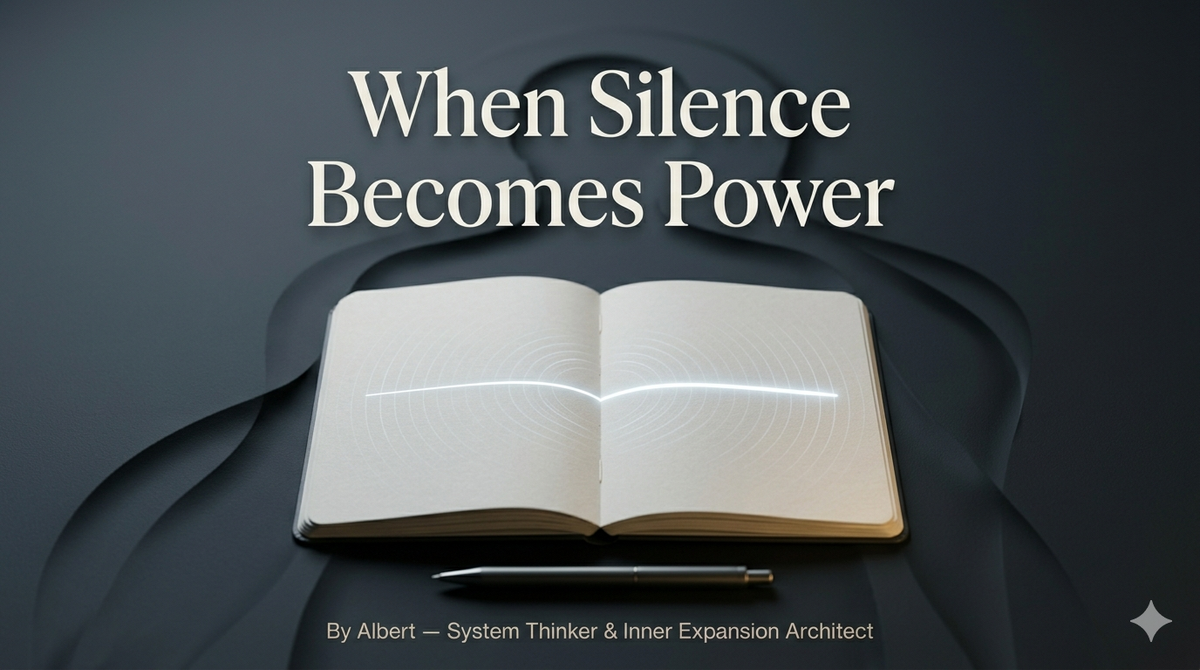
The method is deceptively simple. It is the same method Carl Jung used to write The Red Book. It is the method of silent writing.
You sit alone. No phone. No music. No input. Just you, a pen, and a notebook.
You write whatever arises.
You do not edit. You do not judge. You do not try to make sense of it. You do not try to be profound. You simply let the contents of the unconscious flow onto the page.
For the first five minutes, the ego will perform. It will write polite, safe, surface-level thoughts. "I am tired." "I need to do laundry." "This is silly."
This is the centralized government of your mind, trying to maintain order.
But if you stay. If you write past the five-minute mark. If you refuse to stop, refuse to edit, refuse to judge. Something shifts.
The ego tires. The performance collapses. And the unconscious begins to speak.
This is the moment of the coup.
The unconscious is no longer repressed. It is no longer running the show in the dark. It has been brought into the light of your conscious awareness. You are now the sovereign of your own mind.
You are no longer a subject of your trauma. You are no longer a subject of your fear. You are no longer a subject of the algorithm.
You are a citizen.
Five Laws of Inner Sovereignty
This practice is not just a self-help trick. It is a political act. It is the foundation of participatory governance. Here are the five laws that govern this inner expansion:
1. The Law of the Inner Coup Decentralization cannot begin until the internal dictatorship is overthrown. You cannot demand federalism from the state if you are a tyrant to your own shadow. The inner coup is the prerequisite for the outer coup.
2. The Law of the Simple Mechanism Complexity is the defense mechanism of the centralized power. The ego loves complicated systems because they keep it busy and important. True power is simple. The silent writing practice is so simple that the ego cannot comprehend it. It is the ultimate disruption.
3. The Law of the Embodied Archive The trauma of the state is not just in the laws. It is in the body. It is in the nervous system. Handwriting is the only way to access this archive. Typing is too fast, too digital, too disconnected from the body. The hand must write to release the trauma. The body must speak to heal the state.
4. The Law of the Silent Algorithm The digital algorithm feeds on your attention. It keeps you in a state of reactive chaos. Silence is the only space where the true algorithm of the Self can operate. You cannot hear the voice of the people (or the self) in a room full of notifications. Silence is the only space where constitutional rights can be truly understood.
5. The Law of Indivisible Sovereignty Individuation is the biological equivalent of federalism. Just as power is distributed from the center to the periphery in a federal system, power must be distributed from the Ego to the Self in the psyche. A nation of individuated humans creates a natural, organic participatory governance. You cannot have a decentralized society without decentralized souls.
The Constitutional Convention of the Self
This is not a suggestion. It is a protocol.
If you are serious about building a free society, if you are serious about decentralization, if you are serious about participatory governance, you must begin with the Constitutional Convention of the Self.
Here is the 7-stage protocol for the inner coup:
Stage 1: Awareness (The Call to Convention) Acknowledge that your current internal state is not serving the future you want to build. Acknowledge that you are a subject of your unconscious. This is the moment you decide to call the convention.
Stage 2: Diagnosis (The Audit of the Shadow) Sit in silence. Write. Do not edit. Let the shadow speak. Identify the patterns, the fears, the repressed anger. This is the audit of your internal constitution.
Stage 3: Reframing (The New Preamble) As you write, you begin to see the patterns. You begin to understand the root causes of your behavior. You reframe your understanding of yourself. You write a new preamble to your life.
Stage 4: Intervention (The Ratification) You make the unconscious conscious. You stop the projection. You take responsibility for your own shadows. You ratify the new constitution of the self.
Stage 5: Feedback (The Check and Balance) You continue to write. You monitor the system. You check for old patterns. You ensure that the Ego does not regain its dictatorship. You maintain the balance of power.
Stage 6: Iteration (The Amendment Process) Life changes. The system changes. You continue to write. You amend the constitution as needed. You remain flexible, adaptive, and responsive.
Stage 7: Scaling (The Federal Model) You begin to act in the world. You speak differently. You act differently. You demand different things. You become a model of participatory governance. You inspire others to do the same. You scale the revolution.
From Inner to Outer
What happens when you do this?
In the first week, you will feel restless. The ego will fight back. It will tell you this is a waste of time. It will tell you to go back to the news, to the politics, to the "real work."
Stay.
In the second week, you will start to dream. You will start to remember things. You will start to feel emotions that you have been carrying for years. You will start to see the shadow state in the world with new clarity.
In the third week, the practice will deepen. You will start to see the connections between your internal state and the external world. You will start to see the feedback loops of the system.
In the fourth week, your outer life will begin to shift. You will find yourself making different choices. You will speak up where you used to stay silent. You will set boundaries. You will walk away from situations you could not leave before.
This is the unconscious now in conscious dialogue with the rest of your life. This is the inner coup becoming the outer revolution.
The Cost of Inaction
What happens if you do not do this?
You continue to be a subject. You continue to be a puppet of the algorithm. You continue to be a subject of your own trauma.
You continue to fight for participatory governance while remaining a subject of your own centralized ego.
You continue to demand decentralization while remaining a slave to the centralized state.
You continue to write letters of objection that are ignored because they are written by a mind that has not yet achieved its own sovereignty.
The cost of inaction is the continued stagnation of the human soul. The cost of inaction is the continued collapse of democracy. The cost of inaction is the continued reign of the unconscious state.
The Future of the Decentralized Soul
Imagine a world where every citizen has performed the inner coup.
Imagine a world where every citizen is a sovereign of their own mind.
Imagine a world where participatory governance is not a distant dream, but a natural consequence of individuated souls.
Imagine a world where federalism is not just a political structure, but a psychological reality.
Imagine a world where constitutional rights are not just legal documents, but the internal laws of the self.
This is the future.
This is the future that is available to you.
This is the future that you can start building tonight.
With one notebook. One pen. Ten minutes of silence.
Call to Action
The revolution is not out there. It is in here.
The inner coup is the first act of the outer revolution.
Tonight, before you sleep, sit in silence. Write.
Do not wait for the perfect conditions. Do not wait for the right moment. Do not wait for the government to change.
Change yourself.
Change your mind.
Change your soul.
And then, write your letter of objection.
Write it with the clarity of a sovereign citizen.
Write it with the power of a decentralized mind.
Write it as a declaration of your inner sovereignty.
And then, wait for the world to catch up.
Type Yes in the comments if you commit to the Inner Coup tonight.
Not as performance. As a vow.
As a quiet declaration to yourself and to the field that you are choosing, finally, to stop searching and begin doing.
Subscribe if your soul is hungry for this kind of depth.
Share this with one person you know who has been searching for years for something that actually works. Give them this. Give them the simplest and most powerful practice that exists.
Remember, the thing that changes your life is not what you have been told it is. It is not the new course. It is not the perfect morning routine. It is not the manifestation technique or the productivity system or the lifestyle redesign.
It is the simple act of sitting alone in silence and giving your unconscious permission to speak.
10 minutes a night with a pen in your hand, without an agenda, without an audience, without trying to make it more than what it is.
Do this tonight. And then again tomorrow. And then again the night after.
And watch what happens to your life.
And watch what happens to the world.
By Albert, A System Thinker and Inner Expansion Architect
FAQ Section
Q: Is this just another journaling technique? A: No. Standard journaling is often a tool for the ego to organize its thoughts and maintain control. This practice is designed to bypass the ego entirely, allowing the unconscious to surface. It is a mechanism for individuation and inner sovereignty, not just productivity.
Q: How does this relate to political change? A: True participatory governance requires citizens who are capable of self-governance. You cannot have a free society if the citizens are slaves to their own unconscious patterns. This practice transforms the individual from a subject into a sovereign citizen, which is the prerequisite for any real political shift.
Q: What if I don't have 10 minutes? A: The practice is not about the duration; it is about the quality of attention. Even 5 minutes of true silence and non-judgmental writing can break the loop of the ego. However, 10 minutes is the minimum recommended to allow the ego to tire and the unconscious to speak.
Q: Do I need to analyze what I write? A: No. Analysis is the job of the ego. The goal is to let the unconscious speak and be heard. Analyzing immediately re-engages the performing mind and short-circuits the integration. Trust the process. Close the notebook. Sit in silence.
Q: How long until I see results? A: The first week is often resistant. The second week brings dreams and memories. By the fourth week, you will likely notice shifts in your choices, boundaries, and relationships. The inner coup is immediate, but the outer revolution takes time to manifest.
SEO & Distribution Strategy
Suggested Internal Links:
- https://albertyzacharia.in/home/f/write-in-silence-transform-the-self-a-jungian-practice-guide
- https://wiki.milletify.com/index.php/2026/05/27/the-10-minute-inner-coup-how-silent-writing-rewrites-your-unconscious-operating-system/
Suggested External Sources:
- Carl Jung's The Red Book (for the historical context of silent writing).
- James C. Scott's Seeing Like a State (for the critique of centralized state planning).
- David Graeber's The Utopia of Rules (for the connection between bureaucracy and psychological repression).