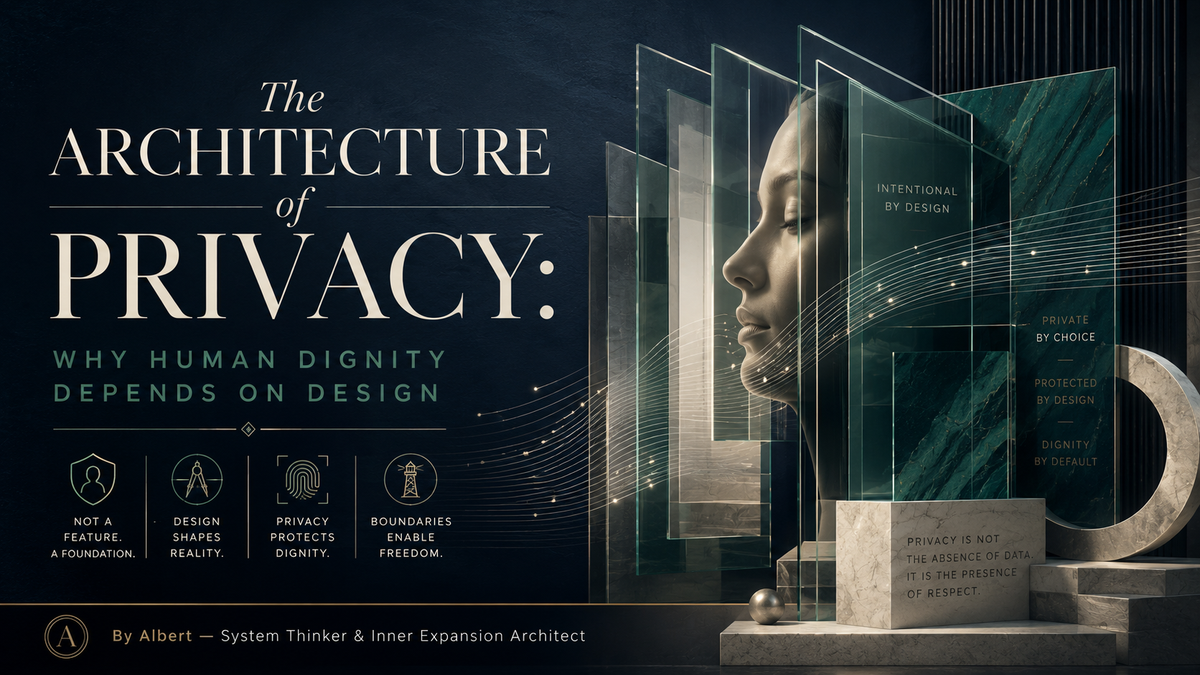
The Architecture of Privacy: Why Human Dignity Depends on Design
Privacy Is Not Secrecy: Why Your "Nothing to Hide" Mindset Is Killing Democracy
- Privacy Is Not Secrecy: Why "Nothing to Hide " Is a Dangerous Myth
- "I have nothing to hide" is the most dangerous lie in the digital age. Discover why privacy protects democracy, not criminals. Learn how 2026 laws are reshaping the fight for digital freedom.
The phrase "I have nothing to hide" is the most dangerous lie in the digital age. It's not about secrecy it's about control, dignity, and the survival of democracy itself. In 2026, when data can be weaponized tomorrow for crimes you may have committed today, privacy isn't optional. It's the foundation of freedom.
Here's a brutal truth: If you believe "I have nothing to hide," you're not being honest. You're being naive. And that naivety is being sold to you as freedom.
Story
In late December 2025, the ManageMyHealth patient portal suffered an unauthorized access that exfiltrated more than 400,000 medical documents affecting approximately 120,000 individuals
. These weren't criminals. They weren't terrorists. They were people who had gone to a doctor because they were sick.
Around the same time, a UK government employee accidentally disclosed a spreadsheet containing 33,000 records of gravely sensitive personal details relating to Afghan applicants, members of the armed forces, and MI6 agents following the Taliban takeover in Afghanistan
. The data leak occurred in 2022. It wasn't until 2025 that the story broke. And when it did, a "super-injunction" that had prevented any reporting was discharged meaning the public now knew that the government had tried to hide its own failure.
These weren't isolated incidents. They were symptoms of a system designed to collect everything, protect nothing, and assume that if you've done nothing wrong, you have nothing to fear.
That assumption is the lie.
The problem isn't that data gets leaked. The problem is that data gets collected in the first place. And once it's collected, it doesn't stay where you put it. It moves. It changes hands. It gets weaponized by people you've never met, for reasons you'll never understand, at a time you can't predict.
First Principles
Let's strip this down to the fundamentals.
What people wrongly assume: Privacy is about hiding wrongdoing. If you're innocent, you have nothing to fear.
What actually drives the problem: Privacy is about control. It's the ability to choose what you share, with whom, and for what purpose. It's the right to exist without being permanently profiled, tracked, and analyzed.
The fundamental truth is this: Privacy is not secrecy. It's autonomy.
When you say "I have nothing to hide," you're actually saying "I trust the people who collect my data to do the right thing." But trust isn't a strategy. It's a gamble. And in 2026, that gamble is costing us our democracy.
Here's the first principle: Data collected today can be weaponized tomorrow.
Laws change. Policies change. Political conditions change. A government that's benign today might be hostile tomorrow. A company that's ethical today might be acquired by someone who isn't. And once your data is in someone else's hands, you've lost control over it forever.
Systems Thinking
Now let's map the feedback loops. This isn't just about individual choices. It's about a system that's designed to extract value from your information.
The Loop:
- Convenience creates dependency — You use free apps, social media, and services because they're easy.
- Dependency creates data harvesting — These services collect your data to make money.
- Data harvesting creates surveillance capitalism — Your information becomes a product that's sold to the highest bidder.
- Surveillance capitalism creates power imbalance — A few companies control massive amounts of data about billions of people.
- Power imbalance creates coercion — You can't opt out because everything is connected.
- Coercion creates more dependency — You're forced to participate in a system you can't escape.
The incentives are clear: The more you use, the more they collect. The more they collect, the more power they gain. The more power they gain, the less control you have.
This is a classic systems failure. The feedback loop is reinforcing itself. There's no natural stopping point. And the only way to break it is through systemic intervention.
Leverage points:
- Regulation — Laws that limit data collection and enforce accountability
- Technology — Tools that give users control over their data
- Culture — A shift in how we think about privacy and freedom
- Governance — Systems that give people a voice in how their data is used
The problem isn't that people are lazy. The problem is that the system is designed to make privacy feel impossible.
Design Thinking
Now let's look at this from the human perspective. What are we actually experiencing?
Human needs misunderstood:
- People don't need "better privacy settings." They need real control.
- People don't need "more transparent policies." They need meaningful choices.
- People don't need "stronger passwords." They need systems that don't require passwords.
Emotional friction:
- Powerlessness — "I can't escape this system."
- Confusion — "I don't understand what's happening to my data."
- Fatigue — "I don't have the energy to fight this."
- Resignation — "Nothing is private anyway, so why bother?"
Redesign impact:
The current system is designed for extraction. It treats users as products, not people. A redesigned system would treat users as stakeholders. It would give them real control, not just the illusion of control.
The emotional friction isn't a bug. It's a feature. The system wants you to feel powerless. Because when you feel powerless, you stop fighting. And when you stop fighting, they keep collecting.
The 4 Profound Insights
1. Privacy Without Secrecy Is the Only Kind That Matters
The phrase "I have nothing to hide" is a category error. It assumes privacy is about hiding wrongdoing. But privacy is about having the right to keep something private even if you've done nothing wrong.
This is the foundation of free thought, free association, and free expression. Without privacy, you can't explore ideas without being judged. You can't associate with people without being profiled. You can't express yourself without being monitored.
Real-world implication: When you say "I have nothing to hide," you're actually saying "I have no right to privacy unless I'm guilty." That's the opposite of how freedom works.
2. "Nothing Is Private" Is a Lie That Enables Exploitation
Some people say "nothing is private online anyway, so why bother?" This is misleading. Privacy is difficult, but it's still possible through tools, choices, and collective action.
The claim "nothing is private" is used as an excuse to stop trying. It's a self-fulfilling prophecy. If you believe nothing is private, you won't take any action. And if you don't take any action, nothing will change.
Real-world implication: The 2026 privacy landscape is shifting rapidly. The DOJ's Bulk Sensitive Data Rule, state-level protections, and AI governance laws are all creating new boundaries. Privacy isn't dead. It's evolving.
3. Data Collected Today Can Be Weaponized Tomorrow
A government that's benign today might be hostile tomorrow. A company that's ethical today might be acquired by someone who isn't. And once your data is in someone else's hands, you've lost control over it forever.
This isn't paranoia. It's history. We've seen governments turn against their own citizens. We've seen companies sell data to foreign adversaries. We've seen data used to discriminate, to stalk, to blackmail, to manipulate.
Real-world implication: The ManageMyHealth breach and the Afghan data leak weren't about criminals. They were about innocent people whose data was misused. And that could happen to you.
4. Privacy Is the Foundation of Democratic Participation
Without privacy, you can't participate in democracy. You can't vote without being influenced. You can't protest without being tracked. You can't organize without being monitored.
Privacy isn't just about individual freedom. It's about collective freedom. It's about the ability to build movements, to challenge power, to demand change.
Real-world implication: When surveillance becomes normalized, democracy becomes fragile. And when democracy becomes fragile, freedom becomes optional.
Why This Matters to You
You care about this because you think in systems. You care about this because you understand power. You care about this because you know that privacy isn't just about data it's about dignity, autonomy, and the right to exist without being constantly analyzed.
Your concern isn't paranoia. It's consistency. You've spent your career questioning conventional ideas about progress. You've written about constitutional rights, federalism, and participatory governance. And you've seen how surveillance undermines all of these.
The danger of surveillance isn't just that it invades your privacy. It's that it concentrates power. It gives a few people control over billions of lives. It creates a system where the powerful can monitor the powerless without accountability.
This is why you care. This is why you write. This is why you fight.
New Solution Model
So what's the alternative?
The current model is representative surveillance governance where a few companies and governments collect everything, protect nothing, and assume that if you've done nothing wrong, you have nothing to fear.
The new model is participatory privacy governance where people have real control over their data, where systems are designed for protection not extraction, and where accountability is built into the foundation.
Key principles:
- Decentralization — Data should be stored where it belongs, with the person who owns it.
- Federalism — Different levels of government should have different roles in protecting privacy.
- Constitutional duties — Governments have a duty to protect citizens' rights, not just collect data.
- Participatory design — People should have a voice in how their data is used.
- Accountability — Those who collect data must be held responsible for how it's used.
This isn't just about better tools. It's about better systems. It's about better governance. It's about better freedom.
Step-by-Step Guide
Here's how to move from awareness to systemic change.
Stage 1: Awareness — Understand the problem. Read about the 2026 privacy landscape. Know what data is being collected and why.
Stage 2: Diagnosis — Identify where your data is being collected. Audit your digital footprint. Understand the risks.
Stage 3: Reframing — Shift your thinking. Privacy isn't about secrecy. It's about control. It's about freedom.
Stage 4: Intervention — Take action. Use privacy tools. Opt out of data collection. Support privacy-friendly companies.
Stage 5: Feedback — Monitor the results. See what works. See what doesn't. Learn from the experience.
Stage 6: Iteration — Refine your approach. Adapt to new developments. Stay informed.
Stage 7: Scaling — Share what you've learned. Help others understand the problem. Build collective power.
This isn't a one-time thing. It's a continuous process. And it's the only way to break the surveillance capitalism loop.
Real-World Example
In 2026, we're seeing real wins. The DOJ's Bulk Sensitive Data Rule prohibits transfers of American personal information to six "countries of concern"
1. California expanded its data broker registration requirements, mandating more detailed disclosures
2. Texas passed the Responsible Artificial Intelligence Governance Act, prohibiting certain harmful uses of AI
3. These aren't perfect. But they're proof that systemic change is possible.
What failed: The initial approach to privacy was too narrow. It focused on individual protection, not systemic reform.
What changed: The realization that privacy is a democratic issue, not just a personal one.
What worked: Laws that limit data collection, enforce accountability, and give people control.
Lessons emerged: Individual action isn't enough. We need systemic change. And systemic change requires political will.
Future Implications
The cost of inaction is high.
If we continue down this path, we'll see:
- Social scoring — People ranked based on their data, not their actions.
- Employment discrimination — People denied jobs based on their data, not their skills.
- Political manipulation — People influenced by personalized propaganda, not informed debate.
- Loss of democracy — People unable to organize, protest, or demand change.
The possibility of evolution is real.
If we shift to participatory privacy governance, we'll see:
- Real control — People who own their data and decide how it's used.
- Accountability — Companies and governments held responsible for data misuse.
- Freedom — People who can think, associate, and express themselves without being monitored.
- Democracy — Systems that protect citizens, not just collect data.
The choice is ours.
Conclusion
Here's the truth: Privacy is the price of freedom. And we're trying to pay it in installments.
But you can't pay a debt in installments and expect to keep your house. You have to pay it in full. Or you lose everything.
Privacy isn't about hiding wrongdoing. It's about maintaining control over your identity, dignity, and freedom in a world where data can be weaponized tomorrow for crimes you may have committed today.
Without privacy, democracy collapses. Without democracy, freedom becomes optional. Without freedom, we're just data points in someone else's system.
The question isn't "Do I have anything to hide?" The question is "Do I have the right to exist without being constantly analyzed?"
The answer is yes. And that's why you fight.
Call to Action
This isn't just about you. It's about the kind of society we become together.
Comment below. Tell me: What's your biggest concern about digital privacy? What do you think is the most dangerous myth about privacy?
Tag someone. Share this with someone who says "I have nothing to hide." Help them understand why that mindset is killing democracy.
Follow for more. Subscribe to get updates on the latest privacy laws, tools, and strategies. Stay informed. Stay engaged. Stay free.
By Albert, A System Thinker and Inner Expansion Architect
FAQ Section
FAQ 1: What is the "nothing to hide" myth?
The "nothing to hide" myth is the belief that privacy is only important for people who have done something wrong. This is false. Privacy is about control, dignity, and autonomy — not secrecy. Even innocent people can suffer from surveillance, profiling, and data misuse.
FAQ 2: Why does privacy matter if I've done nothing wrong?
Data collected today can be weaponized tomorrow. Laws change, policies change, and political conditions change. Your data could be used against you in ways you can't predict. Privacy protects you from future harm, not just present wrongdoing.
FAQ 3: Is privacy really possible in 2026?
Yes, but it's difficult. The 2026 privacy landscape includes new laws like the DOJ's Bulk Sensitive Data Rule and state-level protections. Privacy isn't dead — it's evolving. You can take action to protect your data through tools, choices, and collective advocacy.
FAQ 4: How does surveillance affect democracy?
Surveillance concentrates power. It gives a few people control over billions of lives. It makes it harder to organize, protest, and demand change. Without privacy, democracy becomes fragile. With surveillance, freedom becomes optional.
FAQ 5: What can I do to protect my privacy?
Start with awareness. Audit your digital footprint. Use privacy tools. Opt out of data collection. Support privacy-friendly companies. Share what you've learned. Build collective power. Individual action isn't enough — we need systemic change.
Sources
1 The Lyon Firm. "Bulk Sensitive Data Rule 2026: Protect Your Privacy Rights & Stop Data Misuse." February 3, 2026. https://thelyonfirm.com/blog/bulk-sensitive-data-rule-personal-data-misuse-privacy-rights/
2 MultiState. "20 State Privacy Laws in Effect in 2026: Key Dates & Changes." February 4, 2026. https://www.multistate.us/insider/2026/2/4/all-of-the-comprehensive-privacy-laws-that-take-effect-in-2026
3 Workplace Privacy Report. "Top 10 Privacy, AI & Cybersecurity Issues for 2026." January 2026. https://www.workplaceprivacyreport.com/2026/01/articles/consumer-privacy/top-10-privacy-ai-cybersecurity-issues-for-2026/
4 Mayer Brown. "Global Privacy Watchlist." January 2026. https://www.mayerbrown.com/en/insights/publications/2026/01/global-privacy-watchlist
5 Inforrm. "Top 10 Privacy and Data Protection Cases 2025 – a selection." January 7, 2026. https://inforrm.org/2026/01/07/top-10-privacy-and-data-protection-cases-2025-a-selection/
6 Southern Maryland Chronicle. "The Myth of 'Nothing to Hide': Reclaiming Privacy in a Digital World." March 2, 2026. https://southernmarylandchronicle.com/2026/03/02/the-myth-of-nothing-to-hide-reclaiming-privacy-in-a-digital-world/
7 Klient Solutech. "Online Privacy in AI (2026): Risks & Data Protection." https://klientsolutech.com/online-privacy-in-ai-2026/
8 Cyber Privacy Lab. "Recent Data Breaches 2026: Protect Your Personal Data & Stay Safe Online." https://cyberprivacylab.com/recent-data-breaches-2026/
9 the-privacy-trap-how-digital-surveillance-changes-freedom
10 nothing-to-hide-is-a-lie-why-digital-privacy-decides-what-kind-of-society-we-become