Why Time Feels Faster After 30: The Neuroscience of Neural States and Event Boundaries
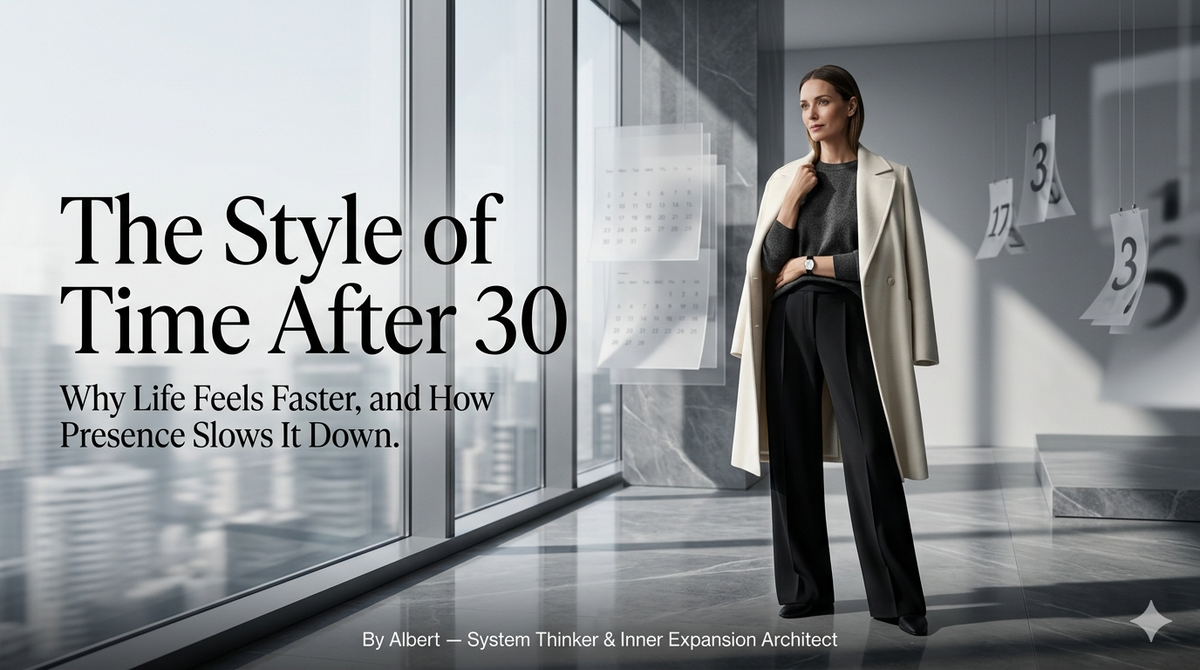
The Neural Blur: Why Time Accelerates After 30 and How to Reclaim the Present
Meta Description: New 2025 research reveals why time speeds up after 30. It's not memory loss; it's neural dedifferentiation. Discover the science of event boundaries and how to slow down subjective time.
Time isn't speeding up. Your brain's editing software just lowered the frame rate. New neuroscience reveals the "neural blur" of aging and the exact mechanism to sharpen your perception of the present.
Opening: You are not losing your mind, and the calendar is not moving faster. Your brain has simply stopped taking the screenshots.
Context & Problem We have all felt it. The summer of your childhood stretched endlessly, a tapestry of infinite detail. The year 2025, by contrast, is already a blur, a gray smear of routine where January and December feel indistinguishable. This is the universal ache of adulthood. For decades, we blamed it on math. The "proportional theory" suggested that a year feels shorter because it is a smaller fraction of your total life. A year is 20% of a five-year-old's existence but only 2% of a fifty-year-old's. It was a neat explanation, but it was wrong.
Recent breakthroughs in neuroscience, specifically a landmark study published in September 2025 analyzing 577 brains from the Cambridge Centre for Ageing and Neuroscience (Cam-CAN), have dismantled the mathematical excuse. The culprit is not the calendar. It is the architecture of your memory. As we age, our brains transition between stable neural states less frequently, lingering longer in each state and creating fewer "event boundaries" where memories are encoded
The result is a phenomenon researchers call temporal dedifferentiation a blurring of time where the edges of our days lose their definition, making months collapse into a single, indistinct memory
First Principles Breakdown To fix the problem, we must strip it down to its fundamental truth. What is time perception?
Most people assume time is a river that flows at a constant speed and we are just floating downstream. This is a category error. Time is not a river. It is a reconstruction.
Your brain does not experience life as a continuous stream. It experiences life as a series of discrete frames, like a film reel. When you encounter a significant change a new street, a surprising conversation, a shift in context your brain marks an "event boundary." It hits the save button. It compresses the data of that moment into a distinct memory block.
The fundamental error in the aging brain is not that it forgets. It is that it stops creating the boundaries in the first place.
A study using an eight-minute Alfred Hitchcock clip revealed that younger brains flip between neural states frequently, marking dozens of transitions. Older brains, however, settle into a single state and stay there for much longer durations, particularly in the visual cortex and the ventromedial prefrontal cortex (vmPFC)
When the brain lingers in one state, it fails to segment the experience. Without segmentation, there are no boundaries. Without boundaries, there are no distinct memories. When you look back on a year of unsegmented routine, your brain has nothing to hold onto. It is a blank page.
The proportional theory is a red herring. The real mechanism is Event Segmentation Density. If you live a year with 500 distinct events, it feels long. If you live a year with 50, it feels like a blink. The math is in the memory, not the clock.
Systems Thinking Analysis This isn't just a biological glitch. It is a systemic failure of modern adult life.
The adult world is designed for efficiency, not segmentation. We optimize our commutes. We automate our finances. We eat the same lunch. We work in silos. We scroll the same feeds. Every time we automate a process, we remove an event boundary. We trade distinctiveness for friction reduction.
Consider the feedback loops at play:
- The Routine Loop: Routine reduces cognitive load. Reduced cognitive load feels good (low stress). Low stress reinforces the routine. The brain, happy with the efficiency, stops firing the "novelty detection" neurons. Fewer novelty signals mean fewer event boundaries. Fewer boundaries mean the experience is stored as a single, low-resolution blob. The brain then seeks more efficiency, deepening the routine.
- The Attention Economy Loop: Digital platforms are engineered to induce flow states. Flow is wonderful for productivity but catastrophic for time perception. In a flow state, attention is so focused that the brain stops marking time. Hours vanish. When the screen goes dark, the user feels a sudden, jarring loss of time. This is not a bug in the app; it is a feature of the design that exploits the brain's tendency to stop segmenting when immersed in a continuous stream.
- The GABA Decline Loop: Biological aging reduces GABA, the neurotransmitter responsible for inhibitory control. Low GABA leads to "neural dedifferentiation," where the brain struggles to distinguish between similar inputs
This makes the brain more prone to collapsing distinct events into a single state, creating a biological feedback loop that accelerates the subjective speed of time.
The leverage point here is not "trying harder." It is introducing friction. The system is optimized for smoothness. To slow time down, you must introduce resistance. You must force the brain to segment.
Design Thinking Application Let’s empathize with the human in the chair. They are not bored. They are terrified.
The feeling of time speeding up is a primal anxiety. It is the sensation of life slipping through your fingers. We treat it as a memory issue, so we buy planners, journals, and productivity apps. These fail because they treat the symptom (forgetting) rather than the cause (lack of segmentation).
The deep human need here is not to "remember more." It is to feel more. We crave the texture of existence. We want to know we were there. The current design of adult life strips away texture. We trade the messy, unpredictable, high-friction reality of a new experience for the safe, low-friction certainty of the familiar.
The redesign requires a shift in how we view "efficiency." We must stop viewing routine as a virtue. In the context of time perception, routine is a thief. The design principle must be Intentional Friction. We need to design lives that are slightly inconvenient, slightly confusing, and slightly new. We need to force the brain to wake up and say, "Wait, this is different."
The 5 Profound Insights Here is the truth that the viral headlines miss.
1. The "Mental Screenshot" Myth is Dead. Popular science tells us older brains take fewer "mental snapshots." This is a simplification that misses the point. The 2025 Cam-CAN study shows that older brains don't just take fewer photos; the film speed itself changes. The neural states become longer and less distinct
It is not that the camera is off. It is that the shutter speed has slowed down, blurring the motion into a single, indistinct smear. The brain is not storing less data; it is storing lower-resolution data.
2. Coarse Boundaries Remain, Fine Details Blur. The most surprising finding is that older adults still recognize the major plot points of a story. When watching the Hitchcock clip, the alignment between neural states and perceived event boundaries remained stable in higher-order regions
We still know when the villain enters the room. We just miss the subtle shift in the lighting, the pause in the dialogue, the micro-expression. The "coarse" segmentation is preserved, but the "fine" segmentation, the texture of the moment, is lost. This explains why we remember the major life events but forget the years in between.
3. Novelty is Not Just "Fun." It is a Metabolic Necessity. Novelty is not a luxury for the bored. It is the fuel for time perception. New experiences trigger the dopaminergic system, which predicts time dilation between events
When you learn a new language, travel to a new city, or take a different route to work, you force the brain to create new event boundaries. This is not just "making memories." It is biologically stretching the fabric of your subjective time. Without novelty, time collapses.
4. The "Flow State" Trap. We are told to seek flow. But flow is the enemy of retrospective time. In a flow state, the brain stops segmenting. Hours pass in a blink because no boundaries were marked. This is why a day of deep work feels like five minutes, while a day of boredom feels like an eternity. The solution is not to eliminate flow, but to balance it with high-friction moments that force the brain to break its trance and re-segment reality.
5. GABA is the Clockwork. The biological underpinning of this phenomenon is the decline of GABA, the inhibitory neurotransmitter. As GABA levels drop, the brain loses its ability to suppress irrelevant information and distinguish between similar neural patterns
This "neural noise" leads to temporal dedifferentiation. The brain becomes a blurry lens. This means that supporting GABA levels through sleep, stress management, and perhaps nutritional support is not just about cognitive health; it is about preserving the integrity of time itself.
New Solution Model: The Segmentation Architecture We need a systemic approach to time design. Let's call it the Segmentation Architecture.
This is not a list of "tips." It is a framework for redesigning your life to maximize event boundary density.
- Principle 1: Disrupt the Loop. Identify your highest-frequency routines (commute, lunch, evening scroll). Introduce one variable that breaks the pattern. Change the route. Eat at a different table. Turn off the screen for 30 minutes.
- Principle 2: Micro-Novelty. You do not need a sabbatical. You need micro-doses of novelty. Learn a new skill for 15 minutes. Listen to a genre of music you hate. Talk to a stranger. The goal is to trigger the "prediction error" response in the brain.
- Principle 3: Attentional Anchoring. Practice mindfulness not to "relax" but to sharpen. The goal is to force the brain to notice the texture of the present moment. When you notice the taste of coffee, the temperature of the air, the sound of a bird, you are creating a boundary.
- Principle 4: The Friction Audit. Regularly audit your life for "too smooth" processes. If something is too easy, make it harder. If you can do it on autopilot, you are losing time.
Step-by-Step Guide: The 7 Stages of Time Reclamation
- Awareness: Acknowledge that your sense of time is a construct. It is not fixed. It is malleable.
- Diagnosis: Map your week. Identify the "gray zones." Where are the blocks of time that feel like a blur? These are your low-segmentation zones.
- Reframing: Shift your goal from "efficiency" to "density." Ask: "How many distinct events can I create in this hour?"
- Intervention: Introduce a micro-novelty. Change one variable in your routine. Take a different path. Learn one new word.
- Feedback: At the end of the day, review your memory. Did you have distinct anchors? Or was it a smear?
- Iteration: Adjust. If the intervention was too easy, increase the friction. If it was too stressful, dial it back. Find the sweet spot of "manageable novelty."
- Scaling: Expand the practice. Move from micro-novelty to macro-novelty. Plan a trip. Learn a new skill. Join a new community.
Real-World Example Consider the case of "The Commuter." For ten years, she took the same train, sat in the same seat, and scrolled the same news app. Her years felt like a single, endless day. She felt time accelerating.
She applied the Segmentation Architecture.
- What Failed: She tried to "meditate" on the train. It didn't work because the environment was too familiar. The brain ignored the internal effort.
- What Changed: She forced external novelty. She took a different train line. She sat in a different car. She started reading a physical book instead of scrolling.
- What Worked: The brain was forced to re-orient. The new scenery, the new sounds, the different physical posture created new event boundaries.
- The Lesson: After three months, she reported that "time had slowed down." The year felt longer because it was filled with distinct memories. The blur had been replaced by a sequence of events.
Future Implications If we do not address this, the cost of inaction is high. We risk living lives that are long in duration but short in substance. We risk becoming "temporal ghosts," present in body but absent in memory.
The possibility of evolution is equally profound. By mastering the Segmentation Architecture, we can reclaim the richness of existence. We can make a single year feel as long as a decade. We can expand our subjective lifespans without changing the calendar. The future belongs to those who can design their own time.
Conclusion Time does not speed up. You stop paying attention.
The 2025 neuroscience is clear. The blur is real. But it is not a death sentence. It is a design flaw. And you are the architect.
Do not wait for a major life event to slow time down. Do not wait for a vacation. The power is in the mundane. The power is in the friction. The power is in the decision to notice.
Look at your hand. Notice the lines. Notice the light. That is an event boundary. That is a moment saved.
Call to Action Comment below: What is one routine you will disrupt this week to reclaim your time? Tag someone who needs to slow down. Follow for more deep dives into the architecture of consciousness.
By Albert, A System Thinker and Inner Expansion Architect
FAQ Section
Q: Why does time feel faster after 30?
A: Because your brain creates fewer "event boundaries" as you age. A 2025 study showed that older brains transition between neural states less frequently, leading to fewer distinct memories and a compressed sense of time
Q: Is the "proportional theory" of time wrong?
A: It is incomplete. While a year is a smaller fraction of your life as you age, the primary driver of the "speed up" is the reduction in novel event encoding, not just the math of age
Q: Can I actually slow down time?
A: You cannot change the clock, but you can change your subjective experience. By introducing novelty and breaking routines, you force your brain to create more memory anchors, making time feel longer in retrospect
Q: What is "neural dedifferentiation"?
A: It is a process where the brain's ability to distinguish between similar neural patterns declines with age. This leads to "blurring" of events and a loss of temporal detail
Q: Does meditation help?
A: Yes, but not in the way you think. Mindfulness can sharpen attention to the present moment, creating more event boundaries. However, it must be combined with novelty to have a lasting effect on time perception
Sources
- Lugtmeijer, S., et al. "Temporal dedifferentiation of neural states with age during naturalistic viewing." Communications Biology (2025).
- Zacks, J. M. "Event Segmentation Theory." Annual Review of Psychology.
- ZME Science. "Why Time Feels Like It Speeds Up as We Age." (2025).